Not every crack is a problem
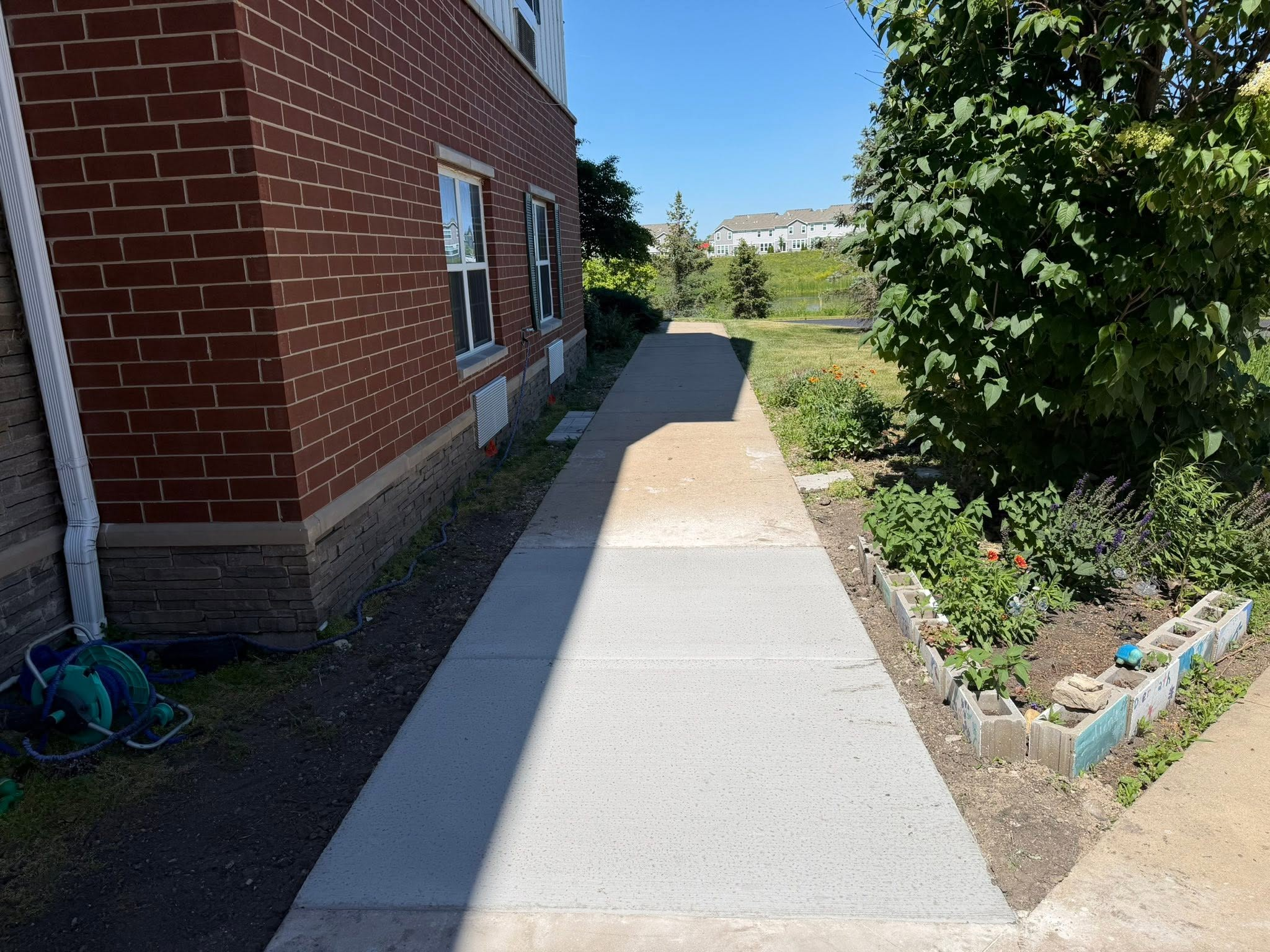
Concrete shrinks slightly as it cures, and it expands and contracts with temperature for the rest of its life. That movement has to go somewhere, which is why sidewalks are built with control joints: grooves that give the slab a planned place to crack. A crack along a control joint is the concrete doing exactly what it was designed to do.
Fine, hairline cracks across a slab are also common. If the two sides are level with each other and the crack is not growing, it is usually cosmetic. Sealing it keeps water out and is often all it needs.
Cracks worth watching
Some cracks are signs of a bigger problem:
- Cracks that keep widening over months or seasons.
- Cracks where one side is higher than the other, which means the slab has moved.
- Several cracks meeting in a web, or a slab broken into pieces.
- Cracks with soil washing out from underneath, a sign water is undermining the base.
- Cracks near trees, where roots can lift and break slabs over time.
Photograph cracks you are unsure about and check them again each season. A crack that changes is telling you something.
Trip hazards come first
On a commercial property, uneven concrete is a liability. A slab edge that sticks up even a small amount is easy for a visitor to catch with a toe.
For walking surfaces on an accessible route, the 2010 ADA Standards set limits on changes in level. Changes up to 1/4 inch may be vertical. Changes between 1/4 and 1/2 inch must be beveled. Anything higher has to be treated as a ramp. In practice, any lifted edge along a walkway deserves attention, and the busiest paths, such as building entrances and the route from accessible parking, should be checked first. Our ADA parking lot checklist covers the rest of that route.
Surface damage: scaling and spalling
Not all concrete damage is cracking. Scaling is when the top layer flakes or peels away, leaving a rough surface. Spalling is when larger chips or pieces break off. Both are common in the Chicago area, where water soaks into the surface, freezes, and expands through the winter, and where deicing salts speed up the damage.
Light scaling is mostly cosmetic. Deep spalling exposes more of the slab to water and can create edges that catch shoes and wheels, so it should be repaired or the section replaced.
Repair options
Many concrete problems can be fixed without removing the slab:
- Crack sealing fills cracks with a flexible sealant that keeps water out.
- Grinding shaves down a raised edge so two slabs meet more evenly, a quick fix for minor trip hazards.
- Slab lifting raises a settled slab back to level by injecting material underneath it.
- Patching repairs small damaged areas and broken edges.
These repairs make sense when the slab itself is mostly sound and the problem is limited to one area.
When replacement makes sense
Replacement is usually the better choice when:
- The slab is broken into several pieces.
- It has settled or heaved too far to correct.
- The base underneath has washed out or failed.
- Spalling or scaling covers much of the surface.
- Tree roots will keep lifting the slab unless the area is rebuilt.
Replacing one section at a time is common. The new slab should match the slope and height of its neighbors, with proper joints, and drain water away from buildings. If water is part of the cause, see our guide to parking lot drainage before the new concrete goes in.
Protect new and repaired concrete
A few habits help concrete last:
- Avoid deicing salts on new concrete during its first winter, and use them sparingly after that.
- Keep downspouts and drainage from sending water across walkways.
- Seal cracks as they appear.
- Recheck walkways each spring, after frost has had its chance to move things.
If you are deciding between concrete and asphalt for a larger area, our comparison of asphalt and concrete for parking lots walks through the tradeoffs.